
 Payment
  My Account
Canada’s commercial trucking sector imports parts at a scale most outsiders underestimate. Fleet operators, distributors, repair shops, and aftermarket retailers move billions of dollars of components across the border every year, from $8 brake pad sets sourced from China to $40,000 transmission assemblies from Germany. The Canada Border Services Agency treats all of it as commercial cargo subject to classification, valuation, origin, and tax treatment that varies by part, by source country, and by intended use.
Truck parts, as a customs category, cover any component, assembly, or accessory designed for use in medium-duty trucks (Class 4 through 6) or heavy-duty trucks (Class 7 and 8). The category includes mechanical components, electronic systems, structural elements, safety equipment, consumables, and a long list of accessories that keep commercial vehicles operating. Whether a shipment is destined for OEM assembly, aftermarket distribution, or fleet maintenance affects the documentation and tax treatment in ways that the industry does not always recognize at the purchase order stage.
This guide explains the customs rules that apply to truck parts imports into Canada in 2026, the trade agreements that affect duty treatment, the regulatory layers beyond CBSA, and the operational practices that separate importers who clear cleanly from those who absorb avoidable cost and risk.
What Qualifies as Truck Parts?
Truck parts cover a broad range of products used in commercial vehicles, heavy-duty transportation equipment, and fleet operations. Depending on the product, truck parts may be mechanical, electronic, structural, or safety-related.
Common examples include:
- Brake components
- Suspension systems
- Engine parts
- Transmission components
- Truck lighting systems
- Sensors and monitoring equipment
- Wheels and rims
- Tires
- Filters
- Exhaust systems
- Fleet telematics equipment
- Truck safety equipment
Many truck parts are imported as replacement components, while others are intended for new vehicle assembly or fleet upgrades.
Why Truck Parts Require Special Customs Attention
Truck parts are not treated as a single customs category. Different parts may fall under entirely different tariff classifications depending on their purpose and technical characteristics.
For example, a shipment might include:
- Mechanical components
- Electronic monitoring devices
- Rubber products
- Lighting systems
- Communication equipment
Because of this diversity, CBSA often pays close attention to classification accuracy, country-of-origin claims, and valuation declarations.
Importers who assume all truck parts share the same duty treatment frequently encounter customs issues later.
Duties and Taxes on Truck Parts
Most truck parts imported into Canada are subject to:
- Customs duties (depending on origin and classification)
- 5% GST
- Provincial taxes where applicable
The duty rate depends on factors such as:
- Product classification
- Country of manufacture
- Eligibility under trade agreements
- Product function
Parts that qualify under CUSMA may benefit from reduced or duty-free treatment when origin requirements are satisfied.
However, not all truck parts automatically qualify simply because they are sourced from North America. Proper origin documentation is critical.
Tariff Classification of Truck Parts under Chapter 8708
Most truck parts imported into Canada are classified under Harmonized System Chapter 8708, which covers parts and accessories of motor vehicles of headings 8701 to 8705. This chapter is where the bulk of the truck aftermarket lives. Within Chapter 8708, the relevant headings include:
- HS 8708.30 for brakes, servo-brakes, and their parts
- HS 8708.40 for gearboxes and their parts
- HS 8708.50 for drive axles and non-driving axles
- HS 8708.80 for suspension systems and their parts
- HS 8708.91 for radiators
- HS 8708.92 for silencers and exhaust pipes
- HS 8708.93 for clutches and their parts
- HS 8708.94 for steering wheels, columns, and boxes
- HS 8708.99 for the catch-all of other parts and accessories
Several major truck parts fall outside Chapter 8708 entirely. Truck tires classify under HS 4011 (new pneumatic rubber tires). Engine parts often fall under HS Chapter 84, with engines themselves under HS 8408 (diesel) or HS 8407 (spark-ignition). Vehicle lighting systems sit under HS 8512. Electrical switches, sensors, and ignition equipment frequently fall under HS 8536 or HS 9032. Fasteners specifically engineered for vehicle use stay under 8708, but generic industrial fasteners may be classified under HS 7318 with a different duty treatment.
The MFN duty rate on most Chapter 8708 parts sits at 6%, though several subheadings carry 0% MFN treatment. Truck tires under HS 4011 generally face 7% MFN duty. The duty difference between a correctly classified part at 0% and the same part incorrectly placed at 6% or 7% adds up quickly on volume orders.
Where classification gets genuinely difficult is with multi-function components. A tire pressure monitoring sensor can be classified as a vehicle part under 8708, as a measuring instrument under 9026, or as an electrical apparatus under 8536, depending on how the product is described and what its primary function is determined to be. The classification decision affects the duty, the trade agreement eligibility, and the documentation pathway. Importers who default to a generic description like “truck sensor” on the commercial invoice are surrendering classification control to whoever happens to be at the CBSA desk that day.
Detailed product descriptions are the foundation of clean classification. Replace generic invoice language like “truck sensor” with specific, technically grounded descriptions like “commercial vehicle tire pressure monitoring sensor, OEM replacement, for Class 8 heavy-duty trucks.” The longer the description, the less interpretation CBSA has to do, and the cleaner the release.
Country of Origin and CUSMA Benefits
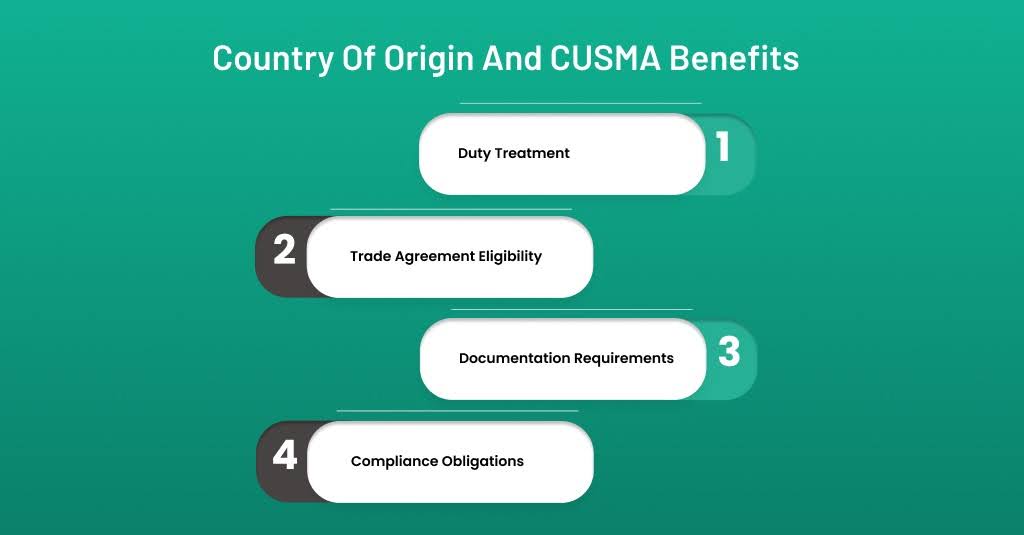
Many truck parts are sourced from the United States, Mexico, Europe, and Asia.
The country of origin affects:
- Duty treatment
- Trade agreement eligibility
- Documentation requirements
- Compliance obligations
Importers seeking preferential treatment under CUSMA should maintain clear records demonstrating that the parts satisfy applicable origin rules.
Failure to properly substantiate origin claims can result in reassessments, additional duties, and penalties.
This is particularly important for products that undergo manufacturing in multiple countries before final assembly.
Other Trade Agreements That Affect Truck Parts Duties
CUSMA gets the majority of attention because the U.S. and Mexico are the largest source countries for truck parts imported into Canada. But several other trade agreements provide preferential duty treatment for truck parts originating elsewhere, and importers who source globally should understand the full picture.
CETA (Canada-European Union Comprehensive Economic and Trade Agreement) provides preferential or duty-free treatment for truck parts originating in EU member states. This matters for importers sourcing German braking systems, Italian electrical components, Swedish heavy-duty truck parts, and similar premium European product lines. CETA has its own rules of origin, distinct from CUSMA, and importers need a properly executed origin declaration from the EU supplier to claim preferential treatment.
CPTPP (Comprehensive and Progressive Agreement for Trans-Pacific Partnership) covers Japan, Vietnam, Malaysia, Singapore, and several other Pacific Rim countries. Japanese truck parts, including the OEM and aftermarket components from manufacturers like Hino, Isuzu, and the heavy parts subsidiaries of major Japanese groups, can qualify for CPTPP preferential treatment when origin requirements are met.
GPT (General Preferential Tariff) and LDCT (Least Developed Country Tariff) provide reduced or zero duty treatment for parts originating in qualifying developing countries. These regimes can apply to certain Indian, Vietnamese, and other Asian-origin truck parts depending on the specific HTS code and origin rule.
The practical lesson is that “where is this part from?” is not a one-answer question for customs purposes. Each agreement carries its own rules of origin, its own documentation requirements, and its own audit risk if the claim cannot be substantiated. Importers running serious global sourcing should be mapping each supplier against each available trade agreement before placing orders.
The China Surtax and Its Impact on Truck Parts Imports
The China Surtax Order, in effect since October 2024, applies a 25% surtax on imports of certain steel and aluminum products of Chinese origin. This surtax is in addition to the standard MFN duty and applies to a list of specific tariff items.
For truck parts importers, the practical implication is that steel-intensive Chinese-origin components, including certain wheel rims, structural components, fabricated brackets, and similar steel-based parts, can face a 25% surtax layered on top of the standard duty. Aluminum components, including certain wheel assemblies and structural parts, face the same 25% surtax where they fall within the covered tariff items.
A 6% MFN duty plus 25% surtax on a $50,000 shipment of Chinese-origin wheels is the difference between $3,000 in duty and $15,500 in duty plus surtax. This is the kind of math that changes sourcing decisions.
Importers should verify whether each Chinese-origin truck part falls within the surtax-covered tariff items before placing an order. Some categories are clearly covered, others are clearly not, and several fall in interpretive territory that benefits from an advance ruling or careful broker review.
The China Surtax Remission Order provides relief in specific circumstances, with several authorization codes available for goods that qualify. Maintaining proper documentation and origin records is the foundation for either avoiding the surtax through accurate classification or claiming remission where applicable.
Electronic and Smart Truck Components
Modern commercial vehicles increasingly rely on advanced electronics and monitoring systems.
Common examples include:
- GPS tracking devices
- Telematics systems
- Electronic control modules
- Driver monitoring systems
- Backup cameras
- Dashcams
- Fleet communication equipment
These products may face additional compliance considerations because they combine automotive functionality with electronic and wireless technologies.
Importers should verify applicable certifications and technical requirements before shipment.
Transport Canada and Federally Regulated Truck Components
Several categories of truck parts fall under Transport Canada regulation in addition to CBSA customs requirements. Importers who treat customs clearance as the only compliance hurdle can find themselves with cleared inventory that cannot be legally installed on a commercial vehicle.
Brake systems and components for vehicles operated commercially are subject to Canadian Motor Vehicle Safety Standards (CMVSS) where they affect compliance of the assembled vehicle. Replacement glass for commercial vehicles needs to meet applicable CMVSS specifications. Lighting systems and reflective devices have their own CMVSS requirements. Tire and rim assemblies for commercial vehicles fall under safety standard treatment that affects both manufacture and installation.
The practical implication is that importing a part is one step. Installing it on a vehicle operating in Canadian commercial service is another. Fleet operators in particular should confirm that imported parts meet applicable Canadian standards before installation, because operating a vehicle with non-compliant safety-critical components creates liability exposure beyond the customs question.
Hybrid and electric truck components add another layer. Lithium-ion battery packs and modules for hybrid and electric commercial vehicles are regulated under the Transportation of Dangerous Goods Regulations and require specific packaging, documentation, and handling. UN 3480 and UN 3481 are the relevant classifications, and importers need carriers and broker partners who understand the dangerous goods compliance side of the import workflow.
Truck Tires and Wheel Components
Truck tires represent one of the most heavily regulated truck-related imports because classification, valuation, and safety requirements all play important roles.
Importers should ensure:
- Accurate tire specifications
- Proper product descriptions
- Country-of-origin documentation
- Compliance with applicable standards
This becomes especially important when importing commercial fleet tires or specialty transportation tires.
Valuation Requirements
Customs valuation affects the amount of duty and tax payable at import.
The declared value generally includes:
- Purchase price
- Packing costs
- Assists supplied by the importer
- Certain royalties or licensing fees
- Freight and insurance where applicable
Truck parts are often purchased through long-term supplier agreements, making it important to properly account for all elements of value.
Under-declaration can lead to reassessments and Administrative Monetary Penalties (AMPs).
CARM Registration and Commercial Importer Requirements
The CBSA Assessment and Revenue Management system, known as CARM, became the operating environment for commercial imports in October 2024. Every importer of truck parts into Canada needs a CARM Client Portal account, a Business Number with an RM import program account, and posted financial security to clear commercial shipments.
CARM replaced the legacy importer-broker financial security relationship with a system where the importer of record is directly responsible for security posting. Brokers can still file declarations on behalf of importers, but the importer carries the underlying obligation.
The practical implications for truck parts importers are several. New importers cannot rely on a broker’s security posting to clear shipments after the CARM transition. Existing importers needed to establish their own security through bond or cash deposit. Commercial Accounting Declarations (CADs) replaced the older B3 form, with adjustment timelines that differ from the legacy process.
Fleet operators, distributors, and repair facilities that import truck parts at any meaningful volume should treat CARM compliance as part of their operational infrastructure. The CARM Client Portal is also the point of access for trade verification notices, refund claims, and adjustment requests. Importers who do not actively manage their CARM account often discover correspondence months after CBSA expected a response, which can cascade into compliance problems.
OEM, Aftermarket, and Remanufactured Parts: Customs Differences
The truck parts market splits into three commercial categories that customs treats differently in important ways.
OEM (Original Equipment Manufacturer) parts are produced by or for the original truck manufacturer. They typically arrive with strong documentation, clear country-of-origin marking, and clean technical specifications. Classification is generally straightforward because the manufacturer has run through the customs analysis already for their own production. The premium price these parts carry reflects, in part, the documentation reliability.
Aftermarket parts are produced by third-party manufacturers to fit specific truck makes and models. They arrive with more variable documentation quality. The classification questions are the same as OEM, but the supporting evidence may be thinner, especially from offshore aftermarket suppliers. Aftermarket parts can qualify for the same trade agreement preferences as OEM if the rules of origin are met, but the burden falls more heavily on the importer to substantiate the claim.
Remanufactured parts are used components that have been rebuilt to original or near-original specifications. The remanufactured truck parts industry is significant in Canada, particularly for transmissions, engines, alternators, starters, and braking components. Remanufactured parts have their own classification considerations and can qualify for specific tariff treatment under certain trade agreement provisions. Documentation should clearly identify the parts as remanufactured rather than used or new, because the three categories carry different compliance pathways.
Used truck parts, distinct from remanufactured, face additional considerations. The fact that a part has previously been in service can affect its classification, its valuation methodology, and in some cases its eligibility for import depending on the part type and condition. Used safety-critical components in particular benefit from broker review before shipment.
Advance Tariff Rulings for High-Volume Truck Parts Importers
Importers who handle significant volume or value in truck parts have a tool available that most do not use: the advance ruling. Under CBSA Memorandum D11-11-3, importers can request a formal, binding ruling from CBSA on the tariff classification, origin, or valuation of a specific product before importation.
An advance ruling provides certainty. Once issued, the ruling is binding on CBSA for the importer and the specific product for several years, subject to a small number of exceptions. For a truck parts importer running tens of thousands of units of a specific component, an advance ruling protects against the scenario where a CBSA verification five years later challenges the classification and triggers a retroactive duty assessment plus interest plus AMPs.
The advance ruling request process is administrative and free of cost, requiring detailed product information, samples where appropriate, and the importer’s analysis of the proposed classification. Working through the request with a customs broker who has handled the process is the standard approach.
Bonded warehouses provide a related operational tool. Importers who maintain meaningful inventory of truck parts can store goods in a Customs Bonded Warehouse without paying duties and taxes until the goods are withdrawn for use or sale. For fleet operators managing seasonal inventory cycles or distributors holding stock for downstream customers, the working capital advantage of duty deferral is significant. The bonded warehouse can hold goods for up to four years under standard treatment.
Documentation Requirements
Commercial Invoice
The commercial invoice should clearly identify:
- Product type
- Part numbers
- Technical descriptions
- Quantities
- Unit values
- Country of origin
Detailed descriptions help CBSA understand exactly what is being imported.
For example:
Instead of:
- “Truck sensor”
Use:
- “Commercial vehicle tire pressure monitoring sensor”
Specific descriptions help reduce delays and classification disputes.
Packing List
A packing list allows customs officials to verify shipment contents.
This is particularly useful for shipments containing:
- Multiple SKUs
- Mixed parts inventories
- Consolidated commercial shipments
The packing list should match the invoice descriptions exactly.
Certificates of Origin
When claiming preferential tariff treatment, origin documentation should be maintained and available upon request.
Incomplete or inaccurate origin records can create significant compliance issues during audits or trade verifications.
What to Expect from a CBSA Trade Verification
CBSA conducts trade verifications on commercial importers across all categories, and truck parts importers are well represented in the verification population because of the volume, the classification complexity, and the active trade agreement claims.
A verification typically begins with a notice from CBSA’s Trade Compliance Programs requesting information about specific imports over a defined period, often two to four years. The importer is given a deadline, usually 30 to 60 days, to provide commercial invoices, tariff classification analysis, origin documentation, and supporting records. CBSA reviews the information and issues findings that may confirm compliance, identify duty adjustments owed, or trigger additional action.
The verification window typically reaches back four years for civil duty adjustments, though Administrative Monetary Penalties can extend further depending on the nature of the finding. AMPs for misclassification, undervaluation, and improper origin claims are tiered based on the importer’s compliance history and the dollar value of the adjustments.
Truck parts importers reduce verification risk by maintaining contemporaneous documentation for every shipment, retaining records for at least six years, and engaging brokers who handle classification and origin work with audit-grade documentation. The importers who survive verifications cleanly are not the ones who happen to be right. They are the ones who have the paper trail to demonstrate they were right.
Common Customs Issues for Truck Parts Importers
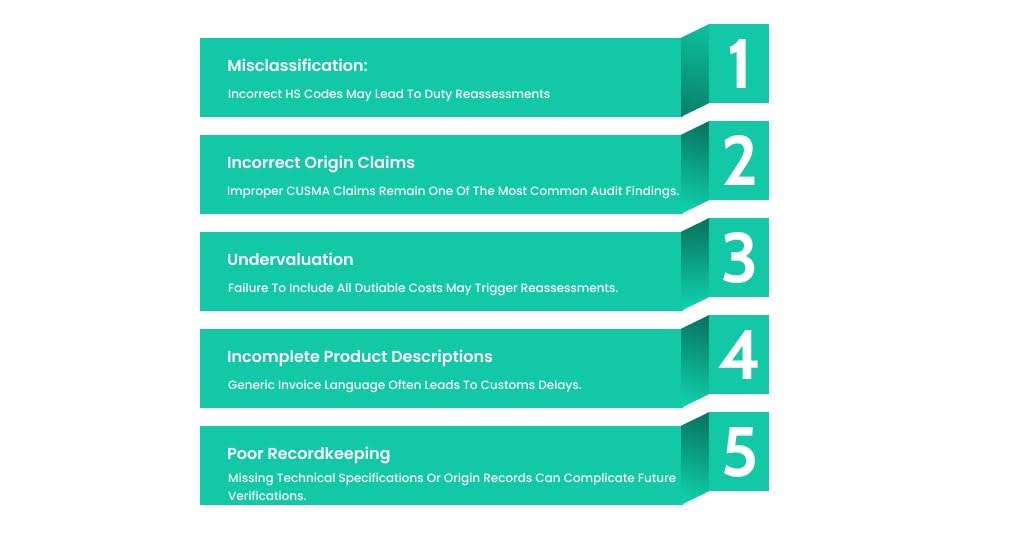
Truck parts importers frequently encounter several recurring customs issues.
Misclassification
Incorrect HS codes may lead to duty reassessments and customs scrutiny.
Incorrect Origin Claims
Improper CUSMA claims remain one of the most common audit findings.
Undervaluation
Failure to include all dutiable costs may trigger reassessments.
Incomplete Product Descriptions
Generic invoice language often leads to customs delays.
Poor Recordkeeping
Missing technical specifications or origin records can complicate future verifications.
Best Practices for Importing Truck Parts
Truck parts importers can reduce risk by implementing strong compliance processes before goods arrive at the border.
Recommended practices include:
- Verify classifications before shipment
- Maintain technical specifications for all parts
- Confirm country-of-origin eligibility
- Prepare detailed commercial invoices
- Review valuation calculations carefully
- Keep complete supporting documentation
- Monitor compliance on an ongoing basis
Importers that take a proactive approach generally experience smoother customs clearance and fewer post-entry issues.
Bringing It Together
Importing truck parts into Canada is not a complicated topic at the headline level. The complexity sits inside the classification decisions, the trade agreement work, the surtax exposure on certain origins, the CARM compliance layer, and the documentation discipline that determines whether a four-year-old shipment survives a CBSA verification.
The importers who do well in this category treat compliance as part of the procurement function rather than as paperwork to figure out after the freight arrives. They get classification right at the purchase order stage. They map suppliers against the available trade agreements. They maintain the documentation that supports every origin claim. They use advance rulings on high-volume parts. They run their CARM accounts actively rather than reactively.
As a digital customs brokerage platform, Clearit Canada works with fleet operators, distributors, repair facilities, and aftermarket retailers across the country on the customs side of truck parts imports. From classification and CUSMA work to surtax analysis and CARM compliance, the operational complexity is what we handle so that importers can focus on running their fleets and their distribution.
Frequently Asked Questions About Importing Truck Parts into Canada
What HS chapter do truck parts fall under in Canada?
Most truck parts are classified under HS Chapter 8708, which covers parts and accessories of motor vehicles. Specific sub-headings within 8708 apply to brakes (8708.30), gearboxes (8708.40), suspension (8708.80), exhaust (8708.92), and other major systems. Truck tires classify separately under HS 4011, engines under HS 8408, and vehicle lighting under HS 8512.
Are truck parts subject to customs duties in Canada?
Yes. Duty rates depend on the product classification, country of origin, and trade agreement eligibility.
Can truck parts qualify for duty-free treatment under CUSMA?
Yes, provided the parts meet applicable origin requirements and proper documentation is maintained.
Are electronic truck components treated differently from mechanical parts?
Often yes. Electronic and wireless products may have additional compliance requirements.
Why is HS classification important for truck parts?
Classification determines duty rates, regulatory treatment, and customs requirements.
Can CBSA verify origin claims after importation?
Yes. CBSA may request supporting documentation during audits or trade verifications.
Do truck tires have separate import requirements?
They may. Tire imports often involve additional classification and compliance considerations.
What documents are required when importing truck parts?
Typically, a commercial invoice, packing list, transportation documents, and origin records where applicable.
How can importers reduce customs delays?
By using accurate classifications, detailed product descriptions, and complete documentation.
