
 Payment
  My Account
For Canadian car enthusiasts, few experiences are as exciting as importing a genuine Japanese Domestic Market (JDM) vehicle. Whether you’ve been dreaming of a Nissan Skyline GT-R, Toyota Supra, Mazda RX-7, Mitsubishi Evolution, or another iconic right-hand-drive (RHD) machine, Canada offers one of the most accessible import pathways in the world.
The key is understanding Canada’s famous 15-year rule.
Many first-time buyers assume importing a car from Japan is complicated. Still, the process becomes much easier once you understand the eligibility requirements, customs procedures, taxes, and registration steps involved. This guide explains everything you need to know before importing a JDM car into Canada.
The 15-Year Rule Is the Foundation of Every JDM Import
Canada’s vehicle import framework is very different from that of the United States. While the U.S. generally requires imported vehicles to be at least 25 years old, Canada permits many vehicles to enter much sooner under the 15-year rule.
The rule is administered under Transport Canada’s vehicle import framework and is one of the primary reasons Canada has become a popular destination for JDM enthusiasts.
If you’re researching how to import a JDM car to Canada, the first thing you must verify is whether the vehicle meets the 15-year eligibility requirement.
What the 15-year rule actually says
Under Canadian regulations, a vehicle becomes eligible for import once it reaches 15 years from its month and year of manufacture.
This is important because vehicles 15 years or older are generally exempt from the Canada Motor Vehicle Safety Standards (CMVSS) requirements that newer imported vehicles must meet.
As of 2026, vehicles manufactured in 2011 or earlier may be eligible, depending on the exact month they were built.
For official guidance, refer to Transport Canada’s vehicle import requirements.
Why the month of manufacture, not the year, decides eligibility
Many buyers make the mistake of looking only at the model year.
Transport Canada measures eligibility using the actual month and year of manufacture, not the model year.
How to Check the Build Date
The 15-year rule is measured by month AND year of manufacture, not model year. A car built in July 2011 is not eligible until July 2026. It cannot legally enter Canada from January through June of that year.
The build date appears on the Japanese export (deregistration) certificate. Always verify it before committing to a purchase.
A vehicle that misses eligibility by even one month may be denied entry.
The Quebec and PEI exception: the 25-year rule
Although federal import rules allow many vehicles into Canada after 15 years, Quebec and Prince Edward Island apply additional registration restrictions.
In these provinces, right-hand-drive vehicles generally must be 25 years old or older before they can be registered for road use.
The federal import process remains the same, but provincial registration requirements can create challenges after customs clearance.
How to Confirm a Specific JDM Car Is Eligible Before You Buy
Before placing a bid at auction or sending payment to a Japanese exporter, verify the vehicle’s eligibility.
This step can save thousands of dollars and prevent customs complications later.
Reading the build date on the Japanese export certificate
The Japanese Export Certificate (also known as the deregistration certificate) is one of the most important documents in the import process.
It confirms:
- Date of manufacture
- Vehicle identification details
- Export status
- Registration history
Many importers request a translated copy before purchasing the vehicle.
Vehicles that are still inadmissible even at 15 years
Although the 15-year rule covers most enthusiast vehicles, importers should still verify:
- Vehicle identity matches documentation
- VIN or chassis number is accurate
- No major documentation discrepancies exist
- Provincial registration requirements can be met
Eligibility does not automatically guarantee registration.

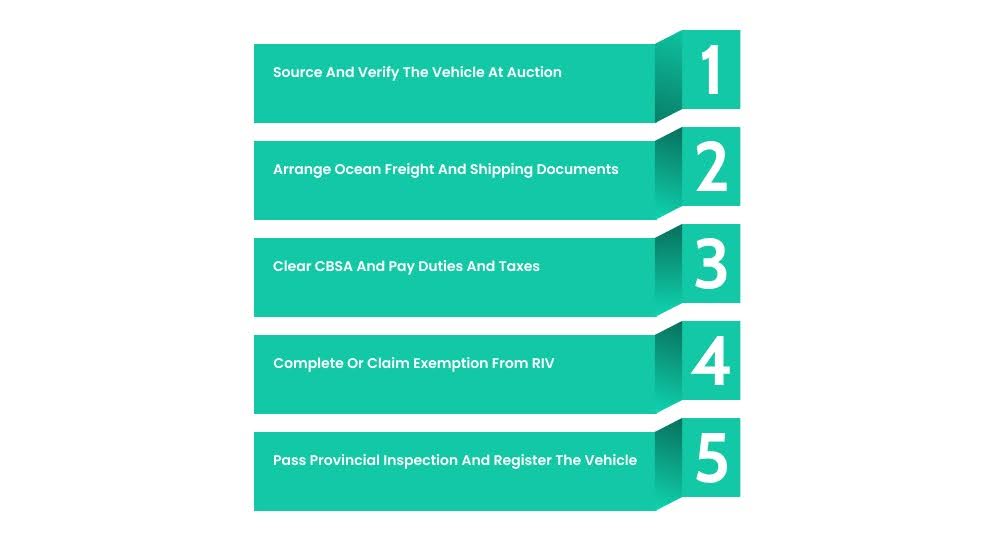
Once you’ve confirmed eligibility, the import process becomes relatively straightforward.
The key is understanding each stage before the vehicle leaves Japan.
Step 1: Source and verify the vehicle at auction
Most Canadian buyers purchase vehicles through:
- Japanese auctions
- Export dealers
- Specialty importers
Review:
- Auction sheets
- Odometer readings
- Vehicle condition reports
- Export documentation
This is often the best opportunity to identify potential issues.
Step 2: Arrange ocean freight and shipping documents
Most JDM vehicles arrive via ocean freight.
Common shipping methods include:
- Roll-on/Roll-off (RoRo)
- Container shipping
Required shipping documents typically include:
- Bill of lading
- Commercial invoice
- Export certificate
- Shipping instructions
These documents will be required for customs clearance.
Step 3: Clear CBSA and pay duties and taxes
Once the vehicle arrives in Canada, it must be cleared through the Canada Border Services Agency (CBSA).
Importers generally need to provide:
- Commercial invoice
- Bill of lading
- Japanese export certificate
- Vehicle details
CBSA assesses:
- Customs duty
- GST
- Applicable excise taxes
Many buyers choose to use our vehicle import service to simplify customs clearance and avoid costly errors.
Buyers who are also researching importing a used vehicle into Canada will find many similarities in the customs process, although JDM imports have unique eligibility requirements.
Step 4: Complete or claim exemption from RIV
The Registrar of Imported Vehicles (RIV) administers Canada’s vehicle import compliance program.
Vehicles that are 15 years old or older are generally exempt from the standard RIV inspection requirements because they are exempt from CMVSS compliance.
Importers should still maintain complete documentation and verify current requirements before importation.
Step 5: Pass provincial inspection and register the vehicle
After customs clearance, the vehicle must pass applicable provincial inspections.
Requirements vary by province but commonly include:
- Safety inspection
- Mechanical inspection
- Registration verification
- Insurance documentation
Right-hand-drive vehicles are legal to drive in every Canadian province and territory, although insurance availability may vary.
What It Costs to Import a JDM Car into Canada
Many enthusiasts focus on the purchase price but underestimate the total landed cost.
The final cost typically includes:
- Purchase price
- Ocean freight
- Customs duty
- GST
- Air conditioning excise tax
- Port fees
- Customs brokerage fees
- Provincial taxes
- Registration expenses
Understanding these costs before purchase helps avoid surprises.
Duty and the CPTPP advantage for Japan-made vehicles
Japan-made passenger vehicles are generally subject to a 6.1% Most-Favoured-Nation (MFN) duty rate.
Depending on the vehicle and origin qualification requirements, preferential treatment under the Comprehensive and Progressive Agreement for Trans-Pacific Partnership (CPTPP) may be available.
Duty treatment should always be confirmed before purchase.
Importers should generally expect:
- 5% GST on imports
- Provincial sales tax or HST upon registration
- $100 air conditioning excise tax (where applicable)
Some provinces may offer tax advantages compared to others.
Documents You Need to Import a JDM Vehicle
Proper documentation is critical for customs clearance.
Most imports require:
- Japanese export (deregistration) certificate
- Commercial invoice
- Bill of lading
- Vehicle details
- Recall clearance letter (where applicable)
- CBSA accounting documentation
- Provincial registration paperwork
Missing documents are one of the most common causes of clearance delays.
Common Mistakes That Get JDM Imports Held at the Border
Most import delays are preventable.
Common mistakes include:
- Failing to verify the build date
- Assuming model year equals eligibility date
- Missing export documentation
- Incorrect vehicle valuation
- Incomplete customs declarations
- Purchasing before confirming admissibility
- Not understanding provincial registration restrictions
We recently assisted with the clearance of a 2009 Nissan Skyline GT-R destined for Ontario. The vehicle itself qualified without issue, but the missing documentation from the exporter delayed customs processing. Fortunately, the issue was resolved before significant storage charges accumulated.
This illustrates why documentation preparation is just as important as vehicle selection.
Frequently Asked Questions
Are JDM cars legal in Canada?
Yes. JDM vehicles are legal in Canada if they meet federal import requirements. Most enthusiasts rely on the 15-year rule to import vehicles that would otherwise not comply with Canadian safety standards.
What is the 15-year rule for importing cars to Canada?
The rule allows vehicles to be imported once they reach 15 years from their month and year of manufacture. Eligibility is determined by the actual build date, not the model year.
Can I import a JDM car into Quebec or PEI?
You may be able to import the vehicle federally, but Quebec and Prince Edward Island generally require right-hand-drive vehicles to be at least 25 years old before registration.
Is it legal to drive a right-hand-drive car in Canada?
Yes. Right-hand-drive vehicles are legal in all Canadian provinces and territories, although insurance requirements vary by provider.
How much does it cost to import a JDM car from Japan?
Costs vary depending on vehicle value, freight charges, duty, GST, excise taxes, brokerage fees, and provincial registration costs. Importers should budget beyond the purchase price alone.
Do I need a customs broker to import a JDM car?
While self-clearance is possible, many importers choose a licensed customs broker to manage CBSA requirements, duty calculations, and documentation for ocean-freight vehicle imports.
Disclaimer
This article is provided for informational purposes only and does not constitute legal or customs advice. Import requirements, duty rates, taxes, and vehicle eligibility rules may change. Always verify current requirements with Transport Canada, CBSA, and a licensed customs broker before purchasing a vehicle.
