
 Payment
  My Account
Automotive parts are one of the largest import categories in Canada, supporting everything from vehicle manufacturing and repair to aftermarket retail. For many importers, the biggest opportunity lies in reducing duty costs through trade agreements, especially CUSMA (Canada–United States–Mexico Agreement).
But while CUSMA can eliminate duties on qualifying automotive parts, it’s not automatic. Eligibility depends on origin rules, documentation, and how well importers understand the requirements.
This guide explains how CUSMA applies to automotive parts imported into Canada, what qualifies, and where importers often go wrong.
What Is CUSMA and How Does It Apply to Automotive Parts Imported Into Canada
CUSMA is a trade agreement between Canada, the United States, and Mexico that allows for reduced or zero duties on qualifying goods. For importers dealing in automotive parts, this agreement can significantly reduce landed costs and improve pricing competitiveness.
However, the benefit only applies when goods meet strict origin requirements. Simply routing goods through the U.S. or Mexico is not enough; compliance must be proven.
CUSMA can offer:
- Reduced or zero duties
- Improved margins
- Competitive pricing advantages
The 2026 CUSMA Joint Review and What It Means for Auto Parts Importers
CUSMA entered into force on July 1, 2020, replacing NAFTA after 26 years. Unlike NAFTA, CUSMA includes a built-in sunset mechanism under Article 34.7: the agreement expires after 16 years unless all three parties agree to extend it. The first Joint Review is scheduled for July 2026, exactly six years after entry into force, and it will determine whether CUSMA continues as written, is renegotiated, or moves toward sunset in 2036.
For automotive parts importers, the 2026 review carries direct operational consequences. Three issues dominate the agenda:
- Rules of origin tightening — the United States has signaled interest in raising Regional Value Content thresholds beyond the current 75% for vehicles
- Steel and aluminum sourcing — proposals to extend the 70% North American purchasing requirement to additional input categories
- Mexican production transshipment concerns — particularly Chinese-origin components entering vehicles assembled in Mexico
Canadian importers should not restructure long-term supply contracts on the assumption that current thresholds will remain stable. CBSA has not signaled administrative changes ahead of the review, but Memoranda updates typically follow within 6 to 12 months of any negotiated amendments.
Which Automotive Parts Qualify Under CUSMA: HS Chapter 87 Mapping
Automotive parts cover a wide spectrum of products, many of which may qualify under CUSMA if they meet origin rules. However, eligibility is not based on product type alone, it depends on how and where the product is made.
Importers often assume that commonly traded parts automatically qualify, but that’s not always the case.
Examples of automotive parts include:
- Engine components
- Brake systems
- Suspension parts
- Electrical systems
- Lighting components
- Filters and consumables
- Interior accessories
Parts similar to tools and hardware, or integrated systems such as automotive electronics, may qualify, but only when the origin criteria are satisfied.
The CUSMA Automotive Appendix: Core, Principal, and Complementary Parts
The single most important regulatory text for automotive parts importers is the Appendix to Annex 4-B of CUSMA, commonly referred to as the Automotive Appendix. This appendix establishes a three-tier classification system that determines which Regional Value Content threshold applies, whether tracing of non-originating materials is permitted, and how strictly origin must be substantiated.
Most importers are unaware that their parts fall into one of these tiers. CBSA, however, applies tier-specific rules during verification.
Core Parts (Strictest Origin Requirements)
Core parts must qualify as originating with no tracing allowed for non-originating materials. The seven core parts categories are:
- Engines (HS 8407, 8408)
- Transmissions (HS 8708.40)
- Body and chassis (HS 8707)
- Axles (HS 8708.50)
- Suspension systems (HS 8708.80)
- Steering systems (HS 8708.94)
- Advanced batteries (lithium-ion, HS 8507.60)
For passenger vehicles to qualify under CUSMA, all core parts must independently meet a 75% RVC under the Net Cost method. This is the highest threshold in any North American trade agreement.
Principal Parts
Principal parts include tires (HS 4011), glass (HS 7007), brakes (HS 8708.30), and other components essential to vehicle operation but not classified as core. Principal parts must meet:
- 70% RVC under the Net Cost method, or
- 80% RVC under the Transaction Value method
Complementary Parts
Complementary parts cover everything else — wiring harnesses, sensors, mirrors, seating components, interior trim, lighting accessories, and most aftermarket items. Thresholds:
- 65% RVC under the Net Cost method, or
- 75% RVC under the Transaction Value method
Why Tiering Matters for Importers
The same shipment may contain parts from multiple tiers, each with different documentation requirements. A box of mixed brake components and wiring harnesses requires separate origin analysis for each line item. Treating them under a single RVC calculation is one of the most common errors flagged in CBSA verifications.
Regional Value Content (RVC): Calculation Methods, Thresholds, and Worked Examples
Regional Value Content is the percentage of a finished part’s value that originates within Canada, the United States, or Mexico. CUSMA permits two calculation methods, and importers may choose whichever yields a higher result — but the choice must be applied consistently across the certification period.
Net Cost Method
RVC=NC NC−VNM×100
Where:
- NC = Net Cost of the good (total cost minus sales promotion, royalties, shipping, and non-allowable interest)
- VNM = Value of Non-originating Materials
Transaction Value Method
RVC = TV- VNM/ TV X 100
Where:
- TV = Transaction Value of the good adjusted to FOB
- VNM = Value of Non-originating Materials
The Transaction Value method is generally simpler but is prohibited for core auto parts and for any calculation involving related-party transactions where the price has been influenced by the relationship.
Worked Example: Aftermarket Brake Caliper Assembly Manufactured in Monterrey, Mexico
| Cost Component | Value (CAD) | Origin |
| Mexican machining and assembly labour | $42 | Originating |
| U.S.-sourced caliper housing | $58 | Originating |
| Mexican brake pads | $24 | Originating |
| Chinese pistons and seals | $31 | Non-originating |
| German precision springs | $15 | Non-originating |
| Overhead, allocated | $18 | Originating |
| Profit | $12 | — |
| Net Cost | $200 | |
| VNM | $46 |
RVC under Net Cost method = (200 − 46) ÷ 200 × 100 = 77%
This brake caliper qualifies as a principal part (threshold: 70% Net Cost). It would also qualify under Transaction Value if the FOB sale price were $215 with the same $46 VNM (RVC = 78.6%, above the 80% threshold? No — fails Transaction Value, passes Net Cost). This illustrates why method selection matters.
Tracing Requirement
For non-core parts, only specific listed materials must be traced under the Tracing List in Annex 4-B. This list focuses on high-value automotive inputs: engines, transmissions, electrical components above defined values, and specified electronics. Materials not on the tracing list are treated as originating once they undergo the required tariff shift, regardless of their actual origin.
Labour Value Content (LVC) and Steel/Aluminum Sourcing Requirements
Labour Value Content is the CUSMA innovation that most distinguishes it from NAFTA. While LVC applies primarily to finished vehicle qualification, parts importers must understand it because LVC compliance at the OEM level cascades into supplier qualification requirements, contract terms, and audit risk allocation.
LVC Thresholds
- 40% for passenger vehicles
- 45% for light trucks
- 45% for heavy trucks (phased through 2027)
LVC is calculated by summing three categories of qualifying expenditure:
- High-Wage Material and Manufacturing Expenditures — at facilities paying an average production wage of at least USD $16 per hour
- High-Wage Technology Expenditures — R&D and IT investment in North America (capped contribution)
- High-Wage Assembly Expenditures — bonus credit for engine, transmission, or advanced battery assembly in qualifying facilities
The USD $16 wage threshold is not indexed to inflation in the original text, though the 2026 review may revisit this. As of 2026, this threshold continues to exclude most Mexican production wages, effectively channeling LVC qualification through U.S. and Canadian labour.
Steel and Aluminum Purchasing Requirement
Vehicle producers must source at least 70% of their steel and aluminum purchases from North America by value. Beginning July 2027, the steel requirement tightens further: steel must be melted and poured in North America to count toward the 70% threshold, eliminating the practice of importing semi-finished steel for finishing in the region.
Why This Matters for Parts Importers
Even if you import only aftermarket or replacement parts not destined for OEM assembly, three downstream effects apply:
- OEM-channel parts buyers increasingly require LVC and steel attestations from their suppliers
- CBSA verification priorities for HS Chapter 87 are influenced by USTR enforcement signals
- Mexican-origin parts using non-qualifying steel may face indirect compliance risk if downstream OEM customers reassess supplier panels
CUSMA Rules of Origin: The Four Origin Criteria for Auto Parts
The rules of origin are the foundation of CUSMA eligibility. These rules determine whether a product is considered “North American” for duty purposes.
In practice, this is where most importers either benefit, or run into trouble.
To qualify, a product must:
- Be wholly obtained in North America, OR
- Be sufficiently transformed within Canada, the U.S., or Mexico
This means:
- A product made in China and shipped through the U.S. does NOT qualify
- A product manufactured or transformed in Mexico may qualify
How CBSA Determines Origin: Tariff Shift, RVC, and Tracing Rules
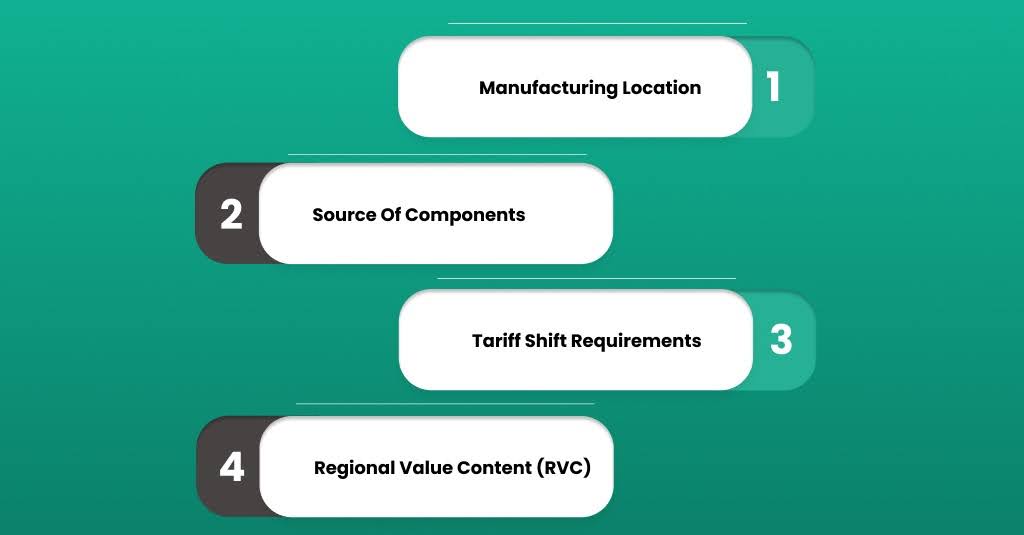
Determining origin is not always straightforward, especially for automotive parts with global supply chains. CBSA evaluates origin based on production details rather than shipping routes.
Importers must understand how their products are made, not just where they are shipped from.
Origin is typically based on:
- Manufacturing location
- Source of components
- Tariff shift requirements
- Regional value content (RVC)
Even small components can affect whether a product qualifies.
CUSMA Duty Savings vs MFN Rates on HS 8708 Auto Parts
The financial impact of CUSMA comes down to whether a product qualifies or not. This difference can be substantial, especially for high-volume importers.
Understanding this distinction is critical when calculating landed costs.
If a part qualifies under CUSMA:
- Duty is typically 0%
If it does not qualify:
- Standard duty rates apply based on classification
CUSMA Certification of Origin: 9 Required Data Elements and CARM Filing
CUSMA benefits are only granted when supported by proper documentation. Even if a product technically qualifies, missing or incomplete paperwork can result in denied claims.
This is one of the most common areas where importers lose out on duty savings.
Certification of Origin
CUSMA does not require a fixed template, but the certification must include:
- Exporter information
- Importer details
- Producer information
- Product description
- Origin statement
- Signature and date
Supporting Documentation
To support claims, importers may also need:
- Commercial invoices
- Bills of materials
- Supplier declarations
- Production records
Top CUSMA Compliance Errors That Trigger CBSA Reassessment
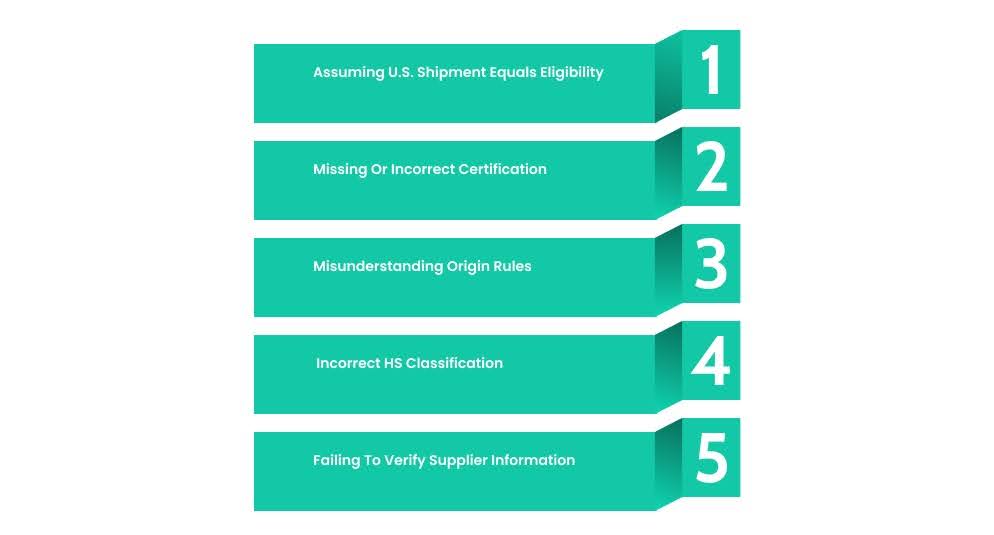
Many CUSMA issues stem from assumptions rather than verification. Importers often rely on supplier claims or incomplete information, which can lead to costly errors.
Understanding these pitfalls can help avoid compliance problems.
Common mistakes include:
- Assuming U.S. shipment equals eligibility
- Missing or incorrect certification
- Misunderstanding origin rules
- Incorrect HS classification
- Failing to verify supplier information
CBSA Verification Under CARM: Filing, Reassessment, and the Compliance Lifecycle
The CBSA Assessment and Revenue Management (CARM) system became the mandatory system of record on October 21, 2024, fundamentally changing how CUSMA claims are filed, tracked, and verified. Every commercial importer into Canada must now hold a CARM Client Portal (CCP) account, post financial security electronically, and file accounting declarations through the portal.
Commercial Accounting Declaration (CAD) Replaces Form B3-3
Under CARM, the legacy Form B3-3 Canada Customs Coding Form has been retired in favour of the Commercial Accounting Declaration (CAD). CUSMA preference is claimed on the CAD using tariff treatment code 10 (United States) or code 11 (Mexico). Errors in tariff treatment code selection are now the most common cause of automated rejection within CARM.
The Verification Process
CBSA conducts CUSMA verifications through three channels:
- Random verification — statistical sampling across all importers
- Risk-based verification — triggered by importer profile, commodity risk score, or supplier history
- Trade Verification Priorities — published semi-annually by CBSA, listing HS chapters under enhanced scrutiny
HS Chapter 87 (vehicles and parts) appeared on the CBSA Trade Verification Priorities list in 2024 and 2025, indicating active enforcement focus on automotive imports.
Recordkeeping Requirements
Under CBSA Memorandum D17-1-21, importers must retain all CUSMA supporting records for six years from the date of import. Required records include:
- Certification of Origin (importer, exporter, or producer-issued)
- Bills of materials with origin designation per component
- Production records demonstrating sufficient transformation
- Cost accounting records supporting RVC calculation
- Supplier declarations and component invoices
- Tracing documentation for listed materials
Reassessment and the DAS Process
If verification identifies non-compliance, CBSA issues a Detailed Adjustment Statement (DAS) reassessing duty, GST, and applicable penalties. Importers have 90 days to file a dispute under Section 60 of the Customs Act. Penalties under the Administrative Monetary Penalty System (AMPS) range from CAD $150 for minor documentation errors to CAD $25,000 per instance for repeat substantive violations.
Voluntary Disclosure
Importers who identify their own CUSMA errors before CBSA does should consider the Voluntary Disclosure Program under CBSA Memorandum D11-6-4. Qualifying disclosures avoid AMPS penalties and limit reassessment exposure to the duty owing plus interest.
Automotive Parts and Complex Supply Chains
Modern automotive manufacturing often spans multiple countries, making origin determination more complex. Parts may be assembled in one country using components from several others.
This complexity increases the risk of incorrect CUSMA claims.
For example:
- Components made in Asia but assembled in Mexico may still qualify
- Products only repackaged or shipped through the U.S. will not qualify
Understanding the full supply chain is essential.
Valuation Still Matters
Even when duties are reduced to zero under CUSMA, valuation requirements still apply. Importers must declare accurate values for tax and compliance purposes.
This is often overlooked when focusing only on duty savings.
Declared value should include:
- Product cost
- Freight (if applicable)
- Assists (e.g., tooling)
- Licensing or royalty fees
Best Practices for Using CUSMA
Applying CUSMA correctly requires a proactive approach. Importers who treat compliance as part of their process, not an afterthought, see the best results.
A structured approach can reduce both cost and risk.
Best practices include:
- Verifying origin before shipping
- Working closely with suppliers
- Maintaining detailed records
- Classifying products accurately
- Reviewing claims regularly
- Preparing for CBSA verification
CUSMA vs CPTPP vs MFN: Choosing the Right Tariff Treatment for Auto Parts
CUSMA is not the only trade preference available to Canadian auto parts importers. Depending on origin and certification capability, three primary treatments compete:
| Tariff Treatment | Code | Applies When | Typical Duty (HS 8708) | Origin Requirement |
| CUSMA – U.S. | 10 | U.S.-origin parts meeting CUSMA RoO | 0% | RVC + tariff shift per Annex 4-B |
| CUSMA – Mexico | 11 | Mexican-origin parts meeting CUSMA RoO | 0% | RVC + tariff shift per Annex 4-B |
| CPTPP | 29 | Japan, Vietnam, Australia, etc. | 0% (phased) | 45% RVC, build-up or build-down |
| Most-Favoured-Nation | 02 | All other WTO origins | 6% (most 8708) | None |
| General Tariff | 03 | Non-WTO origins | 35% | None |
Strategic Considerations
- Japanese auto parts under CPTPP offer 0% duty with simpler RVC calculation and no tracing list — often easier to certify than CUSMA for similar margin outcome
- Korean parts qualify under the Canada-Korea Free Trade Agreement (CKFTA) at 0% duty
- Chinese-origin parts receive MFN treatment at 6% with no preferential pathway
- Dual qualification is permitted — a part qualifying under multiple FTAs can be entered under the most favourable treatment, but documentation must support the chosen pathway
A common error is defaulting to CUSMA for any North American shipment when the underlying part is Asian-origin and would actually require MFN treatment. CBSA’s verification systems flag this pattern automatically.
Conclusion
CUSMA offers a powerful opportunity to reduce duty costs on automotive parts, but it requires more than just cross-border shipping. Origin rules, documentation, and classification all play a role in determining eligibility.
Importers who take the time to understand these requirements can unlock real cost savings while avoiding compliance risks. Those who don’t often face reassessments and penalties.
In today’s enforcement-focused environment, CUSMA should be treated as a strategic tool, not a shortcut.
Frequently Asked Questions
Does shipping automotive parts from the U.S. mean they qualify under CUSMA?
No. CUSMA eligibility is determined by origin, not by shipping route. A part manufactured in China, shipped through Detroit, and re-exported to Canada does not qualify under CUSMA regardless of how many times it crosses the border. To qualify, the part must be either wholly obtained in Canada, the U.S., or Mexico, or sufficiently transformed within the CUSMA region under the Product-Specific Rules of Origin in Annex 4-B. CBSA can reassess claims up to four years after import under CARM if origin cannot be substantiated.
What is the Regional Value Content threshold for auto parts under CUSMA?
RVC thresholds vary by part tier. Core parts (engines, transmissions, body/chassis, axles, suspension, steering, advanced batteries) require 75% RVC under the Net Cost method with no tracing of non-originating materials permitted. Principal parts require 70% Net Cost or 80% Transaction Value RVC. Complementary parts require 65% Net Cost or 75% Transaction Value. Importers should calculate using the method most favourable to qualification but must apply it consistently across the certification period.
What is the difference between Net Cost and Transaction Value methods?
The Net Cost method calculates RVC based on total production cost minus sales promotion, royalties, shipping, and non-allowable interest, divided by net cost. The Transaction Value method uses the FOB-adjusted sale price as the denominator. Net Cost is mandatory for core auto parts and for related-party transactions. Transaction Value is generally simpler but produces lower RVC percentages, requiring higher thresholds. CBSA Memorandum D11-4-2 provides full calculation guidance.
What is a CUSMA Certification of Origin and who can issue it?
A Certification of Origin is the document supporting a CUSMA preference claim. Under CUSMA Article 5.2, it must contain nine minimum data elements: certifier identity, exporter, producer, importer, HS classification to six digits, origin criterion, blanket period (if applicable), authorized signature with date, and a prescribed certification statement. Unlike NAFTA, CUSMA permits the importer, exporter, or producer to issue certification, and no fixed template is required. Certifications can cover a single shipment or a blanket period of up to 12 months.
How does CARM affect CUSMA claims?
Since October 21, 2024, all CUSMA claims must be filed through the CARM Client Portal using the Commercial Accounting Declaration with the appropriate tariff treatment code (10 for U.S., 11 for Mexico). Importers must hold an active CARM account, post financial security electronically, and maintain digital records accessible through the portal. Tariff treatment code errors are now the leading cause of automated CUSMA rejections in CARM.
What records must I keep for CUSMA imports?
CBSA Memorandum D17-1-21 requires importers to retain all CUSMA-supporting records for six years from the date of import. Records include the Certification of Origin, bills of materials with origin designation per component, production records, cost accounting records supporting RVC calculation, supplier declarations, component invoices, and tracing documentation for materials on the Annex 4-B Tracing List. Records must be available in English or French and must be producible within 30 days of a CBSA request.
Can CBSA reassess my CUSMA claim after the goods are released?
Yes. CBSA conducts CUSMA verifications through random sampling, risk-based selection, and the semi-annual Trade Verification Priorities. HS Chapter 87 has appeared on the priorities list in recent cycles, indicating active enforcement focus on automotive imports. If non-compliance is identified, CBSA issues a Detailed Adjustment Statement reassessing duty, GST, and AMPS penalties, with a 90-day dispute window under Section 60 of the Customs Act.
Do I still pay GST on auto parts when CUSMA reduces duty to zero?
Yes. CUSMA only addresses duty, not Goods and Services Tax. The 5% GST applies to the value for tax which equals the customs value plus any duty owing. Even at 0% duty, GST is calculated on the customs value alone. Provincial sales taxes may also apply on registration or resale depending on the province and the nature of the importer’s operations.
What happens if I claim CUSMA preference incorrectly?
CBSA will reassess the duty owing, apply 5% GST on the corrected value, charge interest from the date of import, and may apply AMPS penalties ranging from CAD $150 to CAD $25,000 per instance depending on severity and history. Importers who self-identify errors before CBSA does should file under the Voluntary Disclosure Program in Memorandum D11-6-4 to avoid AMPS penalties and limit exposure to duty plus interest.
Should I use CUSMA or CPTPP for parts from Japan transiting through the U.S.?
CUSMA does not apply to Japanese-origin parts regardless of transit route. CPTPP applies and provides 0% or phased duty treatment under tariff treatment code 29. CPTPP requires 45% RVC under either the build-up or build-down method and uses no tracing list, often making it easier to certify than CUSMA. The choice is dictated by origin, not preference — there is no option to apply CUSMA to non-North American goods.
