
 Payment
  My Account
Tools and hardware are among the most widely imported product categories in Canada. They include everything from precision hand tools and power-driven equipment to fasteners and industrial components. These items are central to manufacturing, construction, retail, and specialty trades.
This guide explains everything an importer needs to know: duties and tariffs, classification challenges, and best practices to avoid enforcement issues.
Why Tools and Hardware Present Unique Import Challenges
Tools and hardware may seem straightforward, but they are anything but in the eyes of customs. These products span a broad range of technical specifications and materials, from simple cast iron wrenches to sophisticated battery-powered machinery. Even small variances can affect:
- Duty rate
- Regulatory compliance
- Customs classification
- Trade agreement eligibility
Two importers bringing in “drills” could owe very different duties if one shipment is a corded power drill, and the other is a cordless lithium-ion unit with accessories.
Because classification affects duty and compliance, CBSA pays close attention to this category. CBSA scrutiny in this category is increasing, particularly as the CARM system amplifies enforcement visibility.
Understanding Duties and Taxes on Tools and Hardware
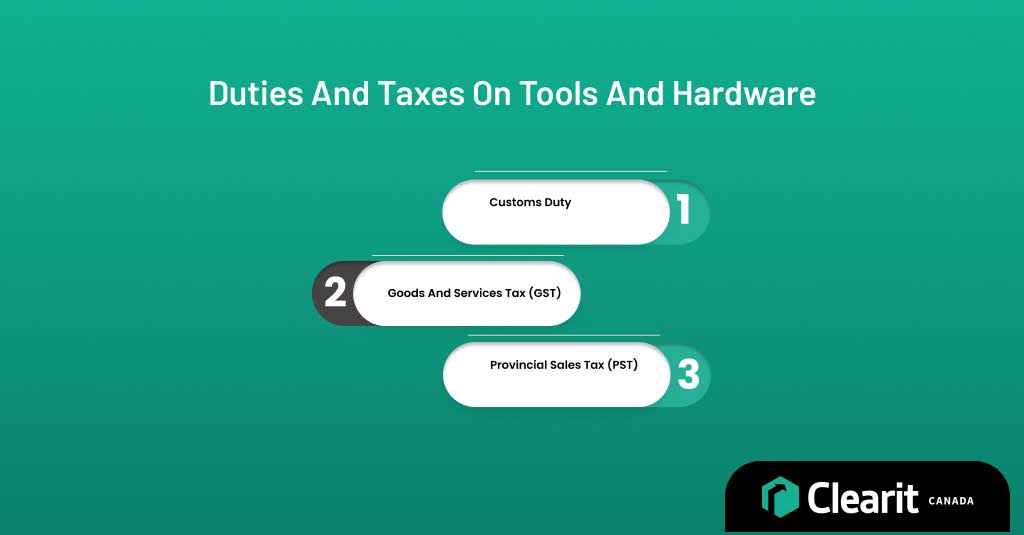
Importing tools and hardware into Canada involves customs duty, GST, and applicable provincial taxes.
Import duties in Canada depend on HS classification, country of origin, and trade agreement eligibility. Most tools and hardware are subject to:
1. Customs Duty
Duty rates vary by product type and origin. For example:
- Basic hand tools may have low duty rates from certain countries.
- Power tools can attract higher duties depending on classification.
- Components like anchors, bolts, and specialized hardware can have varying tariff bands.
Duty rates are accessed through the Customs Tariff Schedule and may be reduced or eliminated if the goods qualify under a trade agreement such as CUSMA.
2. Goods and Services Tax (GST)
GST (currently 5%) applies to all imported goods unless specifically exempt.
3. Provincial Sales Tax (PST) or Harmonized Sales Tax (HST)
Depending on the province where the goods are consumed, PST or HST may apply in addition to GST.
Together, these duties and taxes can add a significant cost layer on top of the product value. Importers must estimate these accurately before the goods cross the border.
HS Classification: The Core Compliance Challenge
Harmonized System (HS) codes determine the duty rate. Classification is often the most misunderstood area for tools and hardware.
Why Classification Is Tricky
Tools and hardware can vary widely in:
- Material (steel, alloy, plastic, composite)
- Function (cutting, drilling, fastening)
- Power source (manual vs electric vs pneumatic)
- Integration (standalone tool vs component of machinery)
Even accessories are often misclassified. For example, a drill bit set bundled with a handheld drill may require separate tariff classification depending on how the goods are packaged and invoiced.
Errors can lead to reassessment of duties, CBSA scrutiny, and penalties. Find out more on CBSA AMPs and penalties.
Accurate classification relies on:
- Precise product descriptions
- Knowledge of tariff schedules
- Correct interpretation of CBSA rules
Inaccurate classification is one of the most common triggers for trade verification and enforcement. Importers should verify HS codes before shipment to ensure correct duty treatment.
Documents You Must Prepare for Importing
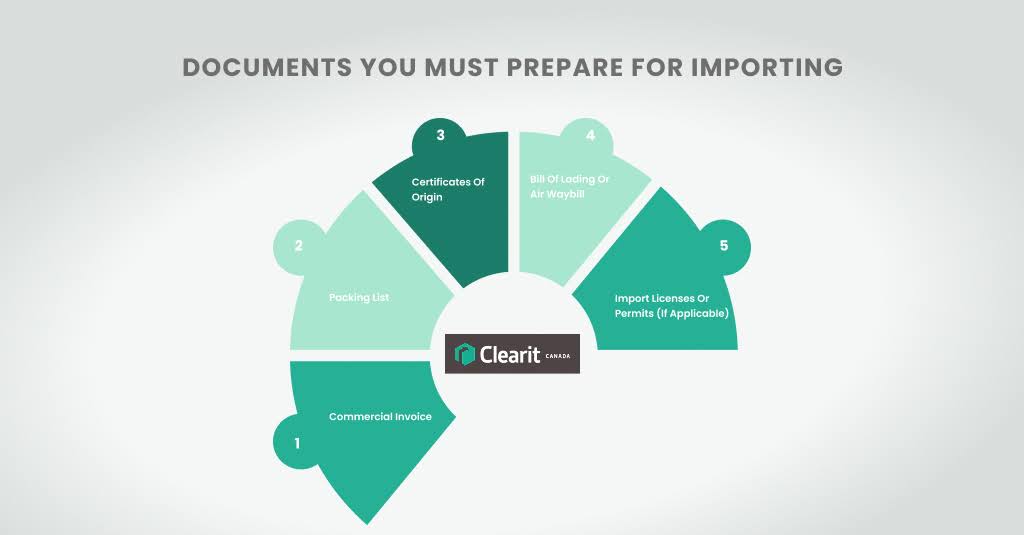
Accurate documentation is critical for smooth CBSA clearance of tools and hardware imports.
Documentation is CBSA’s first line of evidence for compliance. Missing or incomplete documents are a frequent cause of delays.
1. Commercial Invoice
This must include:
- Detailed product descriptions
- Quantities
- Unit values
- Total value
- Country of origin
- HS codes
Vague descriptions like “hardware parts” trigger manual review. Precision reduces hold times and audit risk.
2. Packing List
Helps CBSA confirm what is in each package, especially for consolidated shipments.
3. Certificates of Origin
These may be required to claim preferential duty under trade agreements (e.g., CUSMA).
4. Bill of Lading or Air Waybill
A transportation document that shows how goods moved.
5. Import Licenses or Permits (if applicable)
Although most tools and hardware don’t require permits, some electrical and mechanical equipment might trigger safety or regulatory inspections.
Good documentation not only speeds clearance but reduces the chance of penalties or post-release adjustments.
Valuation: The Broader Picture
Valuation is not just “the invoice price.” CBSA considers the transaction value plus all related costs:
- Freight and insurance
- Packing and handling
- Assist costs (e.g., tooling or materials provided free by the importer)
- Royalties or licensing fees required for the imported products
This total value affects:
- Duty amount
- GST
- PST/HST
- Landed cost projections
Under-declaring costs, even accidentally, can lead to reassessment and Administrative Monetary Penalties (AMPs).
Regulatory and Safety Considerations
Some tools and hardware may be subject to specific safety or regulatory standards at the border. Examples include:
- Electrical safety certifications for power tools
- Battery transport regulations
- Energy efficiency requirements
- Restrictions on hazardous materials
If a product falls under other regulatory bodies (e.g., Health Canada, Transport Canada), additional permits or inspections may apply.
Compliance Risks You Need to Watch
Tools and hardware importers commonly encounter:
1. Misclassification
Misapplied HS codes increase duty exposure and invite trade verification.
2. Inconsistent Product Descriptions
Discrepancies between purchase orders, invoices, and customs entries confuse CBSA and trigger manual reviews.
3. Incorrect Origin Declarations
This affects duty rates and trade agreement eligibility. Errors can lead to reassessment.
4. Treating Complex Commercial Shipments as Casual Imports
High-value commercial shipments mistakenly declared as non-commercial create compliance exposure. It is important to understand the difference between commercial and casual importers before declaration.
These risks are not isolated. They accumulate, attract enforcement attention, and sometimes lead to trade verifications or compliance actions.
Best Practices for Importing Tools and Hardware
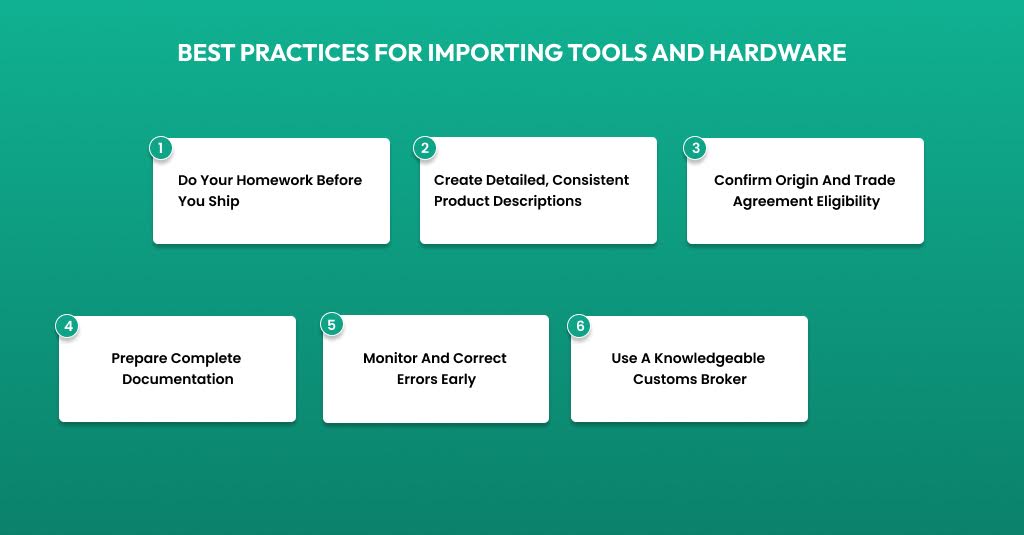
Following best practices helps importers reduce delays, avoid penalties, and maintain compliance when importing tools and hardware into Canada.
1. Do Your Homework Before You Ship
Verify HS classifications, duty rates, valuation components, and regulatory requirements before the goods leave the supplier.
2. Create Detailed, Consistent Product Descriptions
Avoid generic terms. Include brand, model, material, and function.
3. Confirm Origin and Trade Agreement Eligibility
Accurate origin declarations can reduce duty under preferential trade agreements.
4. Prepare Complete Documentation
A consistent commercial invoice, packing list, and certificates help avoid delays.
5. Monitor and Correct Errors Early
If you identify an error, consider a prior disclosure to CBSA to avoid penalties.
6. Use a Knowledgeable Customs Broker
High-value or complex shipments benefit from professional customs support. Read our quick start guide for more information.
Conclusion
Tools and hardware are essential products in many Canadian supply chains, but they come with compliance complexity. Getting classification, valuation, origin, and documentation right is not just good practice, it’s a business imperative.
Proactive planning, precise documentation, and compliance awareness keep goods moving, avoid penalties, and make customs interaction predictable rather than reactive.
In today’s enforcement-driven environment, importers who treat customs compliance as part of their operational strategy gain both control and business advantage.
FAQs
Are tools and hardware subject to customs duty in Canada?
Yes. Most tools and hardware are subject to customs duty and GST, depending on their tariff classification and country of origin.
Do all tools fall under the same HS classification?
No. HS codes vary based on material, function, power source, and whether the tool is manual or powered.
Are power tools treated differently from hand tools?
Yes. Power tools often attract different duty rates and may be subject to additional regulatory requirements.
Can tools and hardware qualify for duty-free treatment?
Some items may qualify under trade agreements such as CUSMA if origin requirements are met.
What documentation is required to import tools into Canada?
At minimum, importers must provide a commercial invoice, packing list, and proof of origin where applicable.
