
 Payment
  My Account
U.S. Customs and Border Protection (CBP) is tightening documentation enforcement across every import category, and Canadian exporters are feeling the pressure. What used to pass with minimal scrutiny is now triggering holds, queries, and even penalties. With trade volume between Canada and the U.S. at historic highs, CBP expects cleaner, more accurate data than ever before.
For Canadian exporters, one truth has become clear: documentation quality is now the #1 risk factor at the border.
Why Documentation Pressure Is Rising for Canadian Exporters
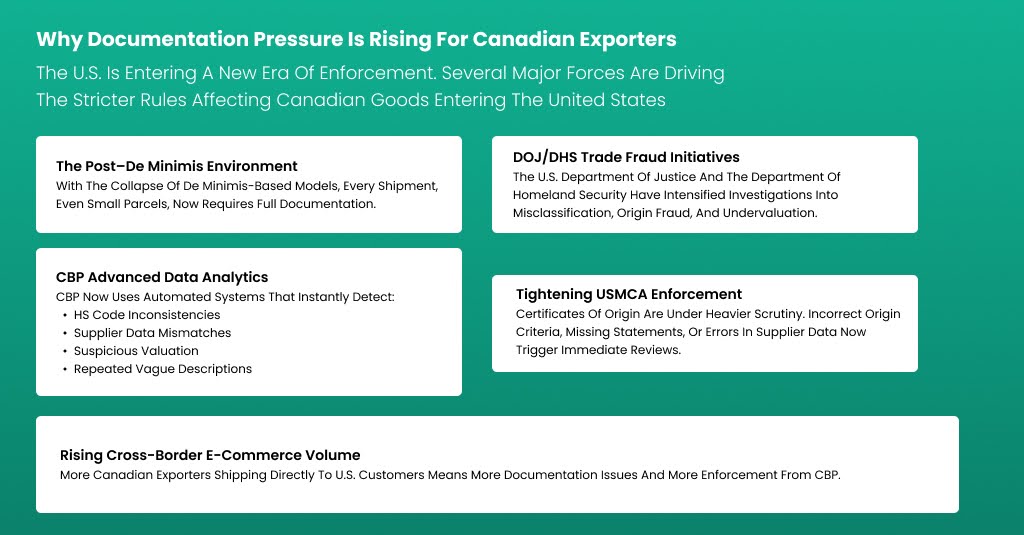
The U.S. is entering a new era of enforcement. Several major forces are driving the stricter rules affecting Canadian goods entering the United States:
1. The Post–De Minimis Environment
With the collapse of De Minimis-based models, every shipment, even small parcels, now requires full documentation.
Exporters must follow the same standards used for full-scale imports.
To guide these new expectations, many exporters start with a U.S.-ready commercial invoice framework.
2. DOJ/DHS Trade Fraud Initiatives
The U.S. Department of Justice and the Department of Homeland Security have intensified investigations into misclassification, origin fraud, and undervaluation.
More on these audit trends can be found in Clearit’s overview of U.S. customs audits impacting Canadian businesses.
3. CBP Advanced Data Analytics
CBP now uses automated systems that instantly detect:
- HS code inconsistencies
- Supplier data mismatches
- Suspicious valuation
- Repeated vague descriptions
A single discrepancy can flag an entire shipment.
4. Tightening USMCA Enforcement
Certificates of origin are under heavier scrutiny. Incorrect origin criteria, missing statements, or supplier data errors now trigger immediate reviews.
5. Rising Cross-Border E-Commerce Volume
More Canadian exporters shipping directly to U.S. customers means more documentation issues and more enforcement from CBP.
In short, documentation errors once overlooked are now clear red flags.
The Documents U.S. Customs Cares About Most
Below is what CBP examines most closely, and the most common mistakes exporters still make.
1. Commercial Invoice
A U.S.-ready invoice must include:
- Clear product descriptions
- Accurate HS codes
- Country of origin
- Incoterms
- Unit value and total value
Missing any of these fields leads to holds. For exporters needing a full template, reference: What to Include in a U.S.-Ready Commercial Invoice
2. USMCA Certifications
Errors include:
- Incorrect origin criteria
- Missing supplier declarations
- Expired certificates
- Unsigned forms
Any of these issues results in the removal of preferential tariff benefits.
3. Packing Lists
CBP pays close attention to:
- Weight discrepancies
- Missing SKU-level details
- Mismatched item counts
4. Certificates of Origin (Non-USMCA)
Critical for:
- Apparel
- Industrial Components
- Food and Agricultural Goods
Certificates must be complete, consistent, and match all invoice data.
5. PGA Documentation
Partner Government Agencies (PGAs) include:
- FDA
- USDA
- CPSC
- EPA
If a product requires PGA documentation and it’s missing, CBP will not release the shipment.
Top Documentation Errors Triggering U.S. Customs Holds in 2025
These are the mistakes Canadian exporters must eliminate immediately:
- Vague descriptions like “accessories,” “general goods,” or “samples.”
- Inconsistent HS codes used across shipments
- Missing or incorrect country of origin
- The invoice value does not match the payment documents
- Supplier-created invoices with missing fields
- Incorrect USMCA claims
- Missing fibre content details (apparel)
- Missing material breakdowns (electronics, furniture)
- Outdated invoice templates from pre–2024 standards
Even a single issue can hold a shipment for days.
How Stricter Documentation Rules Are Affecting Canadian Exporters
Exporters are already experiencing new challenges:
- Higher inspection rates
- Longer courier and trucking delays
- Carriers are refusing to move loads without pre-clearance documentation
- Rejected shipments at the border
- Increased storage and warehouse fees
- Customs reprocessing charges
- Lost retail and wholesale customers due to unpredictable timelines
- Greater audit exposure for NRIs shipping directly to U.S. fulfillment centres
Exporters using consolidation strategies, such as those referenced in lowering costs through U.S. shipment consolidation, often handle documentation more efficiently and reduce these risks.
How Canadian Exporters Can Prepare: A Step-by-Step Documentation Strategy
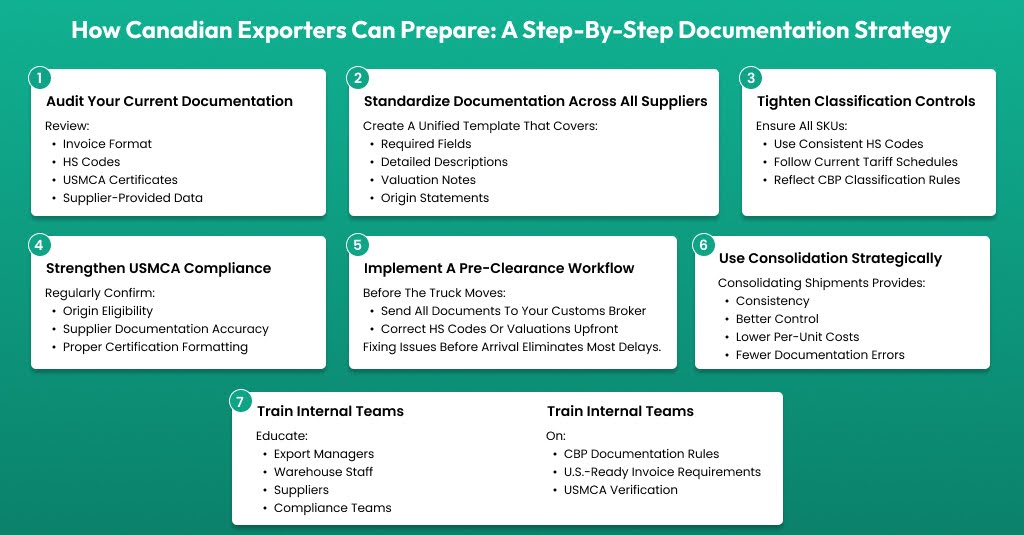
Step 1: Audit Your Current Documentation
Review:
- Invoice format
- HS codes
- USMCA certificates
- Supplier-provided data
Step 2: Standardize Documentation Across All Suppliers
Create a unified template that covers:
- Required fields
- Detailed descriptions
- Valuation notes
- Origin statements
Step 3: Tighten Classification Controls
Ensure all SKUs:
- Use consistent HS codes
- Follow current tariff schedules
- Reflect CBP classification rules
Step 4: Strengthen USMCA Compliance
Regularly confirm:
- Origin eligibility
- Supplier documentation accuracy
- Proper certification formatting
Step 5: Implement a Pre-Clearance Workflow
Before the truck moves:
- Send all documents to your customs broker
- Correct HS codes or valuations upfront
Fixing issues before arrival eliminates most delays.
Step 6: Use Consolidation Strategically
Consolidating shipments provides:
- Consistency
- Better control
- Lower per-unit costs
- Fewer documentation errors
See Clearit’s guidance: Canadian e-commerce brands using consolidation to lower U.S. costs
Step 7: Train Internal Teams
Educate:
- Export managers
- Warehouse staff
- Suppliers
- Compliance teams
on:
- CBP documentation rules
- U.S.-ready invoice requirements
- USMCA verification
Clearit’s Quick Start Guide to Stress-Free Importing is a good foundational resource.
Conclusion
Documentation is now the biggest friction point in Canada–U.S. trade. Exporters who adapt their workflows, standardize paperwork, and implement pre-clearance processes will experience faster border crossings, fewer holds, and stronger compliance.
The border is no longer forgiving; accuracy and consistency are now mandatory.
Before your next shipment leaves the warehouse, make sure your documentation is fully compliant and audit-ready.
For exporters managing scenarios such as goods returning to Canada, Clearit Canada Platform provides the resources needed to avoid costly errors.
FAQs
1. Do Canadian exporters need a U.S.-ready invoice template for every shipment?
Yes, CBP requires consistent, complete, and detailed invoices for every import.
2. Can carriers fix documentation errors for exporters?
No. Carriers cannot correct HS codes, valuation, USMCA certificates, or invoice data.
3. How often should HS codes be reviewed?
At least annually, or whenever adding new SKUs or switching suppliers.
4. What documentation issues most commonly trigger U.S. audits?
Misclassification, vague descriptions, incorrect origin, valuation discrepancies, and incorrect USMCA claims.
5. Do small exporters face the same scrutiny as large companies?
Yes. CBP applies the same documentation rules to all exporters.
6. How does USMCA documentation tie into U.S. customs rules?
Incorrect or incomplete USMCA certificates remove tariff benefits and trigger secondary reviews.
