
 Payment
  My Account
In 2025, cross-border trade between the U.S. and Canada has entered a new era. With the U.S. phasing out its $800 de minimis threshold, new enforcement task forces targeting import fraud, and tightened documentation rules across North America, trade compliance has never been more critical.
For Canadian importers and exporters, this means one thing: the days of “just ship it” are over.
If your truck doesn’t have a licensed customs broker managing its entry paperwork, it might not move at all.
The Changing Landscape of Cross-Border Trade
For years, many small and mid-sized Canadian businesses shipped to or from the U.S. without much friction. Parcels under $800 are automatically cleared through customs under Section 321, often by couriers with minimal data.
But now, with the end of de minimis, every shipment, regardless of value, will require a formal entry. That includes:
- Accurate tariff classification (Harmonized System/HS codes)
- Verified country of origin and supplier documentation
- Correct customs valuation and declared currency
- Registered Importer of Record (IOR)
- Complete supporting documents — including commercial invoice, packing list, and bill of lading
Without these validated data points, your shipment cannot legally clear CBP inspection or enter the U.S. marketplace.
For a breakdown of what that documentation looks like, check out What to Include in a U.S.-Ready Commercial Invoice: A Canadian Importer’s Guide.
Why Brokers Are Now Essential
In 2025, CBP (U.S. Customs and Border Protection) and CBSA (Canada Border Services Agency) will have both adopted stricter data validation and audit protocols.
That means your carrier or courier can’t file customs entries without a licensed broker. The broker’s role is no longer optional; it’s the bridge between your business and border clearance.
Here’s why your next cross-border shipment literally depends on one:
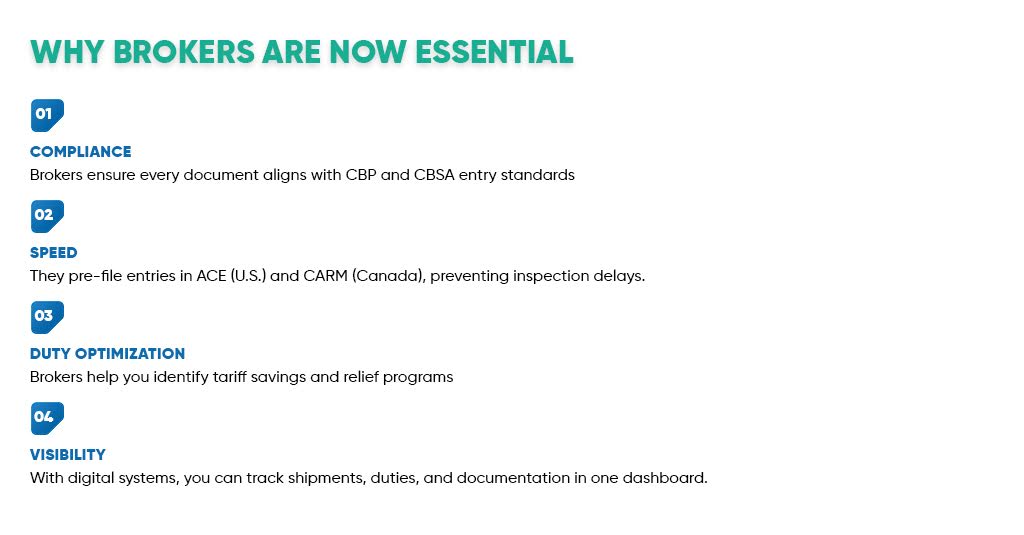
- Compliance: Brokers ensure every document aligns with CBP and CBSA entry standards.
- Speed: They pre-file entries in ACE (U.S.) and CARM (Canada), preventing inspection delays.
- Duty optimization: Brokers help you identify tariff savings and relief programs.
- Visibility: With digital systems, you can track shipments, duties, and documentation in one dashboard.
For more on compliance readiness, explore The Rise of Audits: How Canadian Businesses Can Prepare for Stricter U.S. Enforcement.
When Your Carrier Isn’t Enough
In the past, courier services like UPS, FedEx, and DHL often acted as “default” brokers for low-value goods.
That model no longer works. Carriers handle transportation, not regulatory compliance, and their systems were never built for full entry management under formal customs declarations.
As new U.S. rules take effect, importers relying solely on couriers are facing:
- Inconsistent duty calculations
- Incorrect HS codes and origin declarations
- Delays at ports and land crossings
- Higher administrative fees for “manual” filings
Bottom line: Couriers move packages; brokers move paperwork. You now need both.
If you’re transitioning from courier to broker-managed shipping, our Quick-Start Guide to Stress-Free Importing outlines exactly how to get started.
Consolidation: The Smart Way Forward
One of the biggest cost-saving strategies in 2025 is shipment consolidation, grouping multiple U.S.-bound orders into a single bulk shipment for customs clearance.
With a broker’s support, consolidation reduces per-shipment costs, simplifies documentation, and minimizes inspection risks.
As explained in How Canadian E-Commerce Brands Can Lower Costs by Consolidating Shipments into the U.S., this strategy helps you:
- File one customs entry instead of dozens
- Negotiate better freight rates
- Ensure consistent HS classification across products
- Speed up last-mile delivery through U.S. fulfillment centers
It’s a logistics win-win, but only when coordinated with a licensed customs broker.
Avoiding Costly Cross-Border Pitfalls
Without a broker managing your entries, even simple mistakes can lead to serious issues:
| Mistake | Result |
|---|---|
| Missing or vague product descriptions | CBP holds shipment for clarification |
| Incorrect HS codes | Overpayment or underpayment of duties |
| Unverified country of origin | USMCA benefit denial |
| Duplicate entry values | Delayed release or audit risk |
Some importers also get hit with “double duty”, paying tariffs twice when goods return to Canada after being exported.
Learn how to prevent that in Avoiding Double Duty: Canadian Importers Navigating Goods Returned from the U.S..
The Broker’s Role in 2025: More Digital, Less Paper
Modern customs brokers are not just paperwork processors; they’re digital trade partners.
Through automation, e-invoicing, and data integration with CBP and CBSA, they:
- File entries instantly through ACE and CARM
- Verify HS codes and origin data in real-time
- Securely store trade records for audits
- Provide dashboards for duty tracking and compliance analytics
By partnering with a digital-first broker like Clearit Canada, importers can handle cross-border shipments seamlessly without manual paperwork, phone calls, or surprise fees.
Conclusion
In 2025, cross-border trade runs on compliance, not convenience. The trucks that move on time will be the ones backed by complete documentation, accurate classification, and licensed brokerage support.
If your business moves goods across the U.S.–Canada border, make sure your customs process is as modern as your logistics.
Don’t let your next truck stop at the border.
Start simplifying your cross-border compliance today with our Quick-Start Guide to Stress-Free Importing and ensure every shipment moves smoothly in 2025 and beyond.
FAQs
Q1: Can my trucking company handle customs clearance on my behalf?
Not entirely. Carriers can transport your goods, but cannot replace a licensed customs broker’s role in compliance and duty calculation.
Q2: What happens if I don’t use a broker?
Your shipment may be held at the border until a valid entry is filed, causing costly delivery delays.
Q3: Do all shipments now require a licensed customs broker in 2025?
Yes. With the elimination of de minimis, every cross-border shipment (regardless of value) needs a formal entry.
Q4: Can brokers help me find duty savings?
Absolutely. Brokers identify tariff exemptions, relief programs, and optimal valuation strategies to minimize costs.
Q5: Is digital brokerage really faster?
Yes, automated filing tools drastically reduce clearance times compared to manual or courier-based processes.
